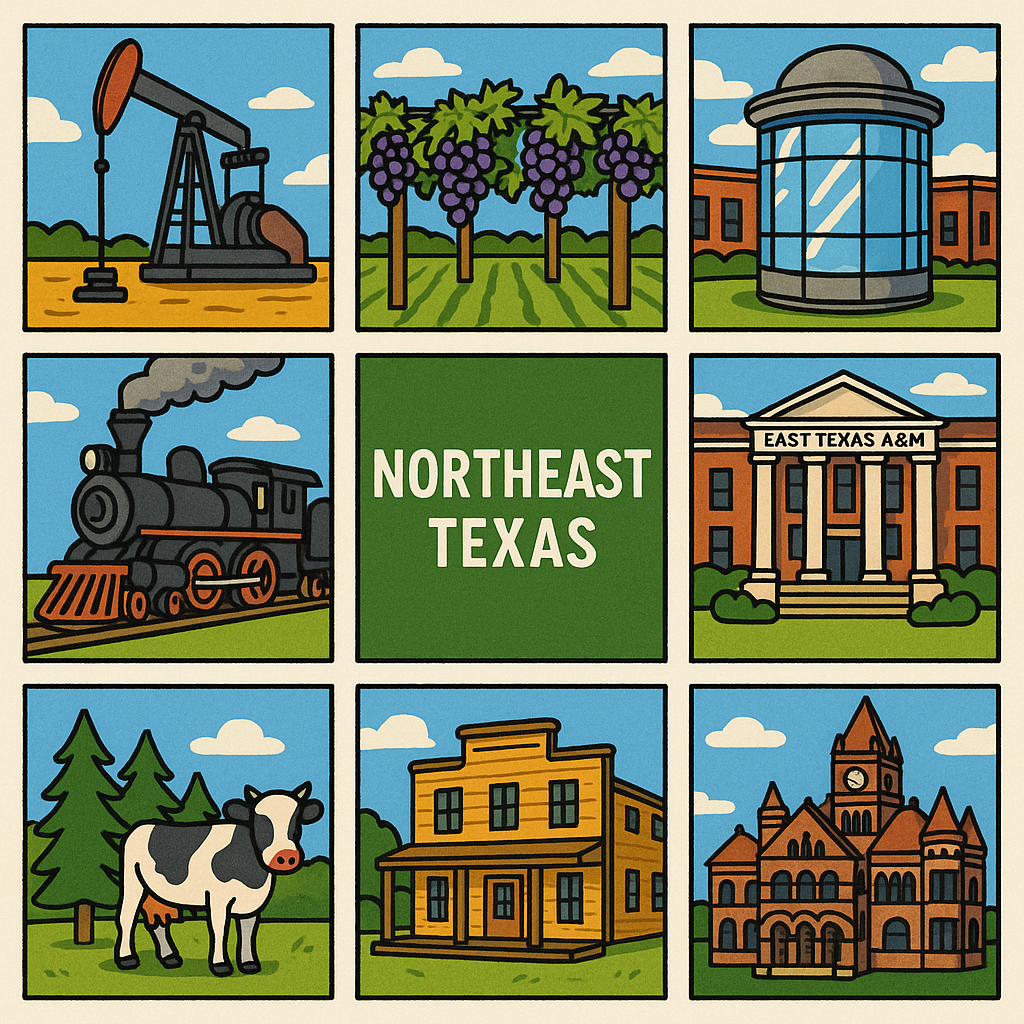
Northeast Texas is unique and individually defined from East Texas. Also called the “upper right” side of Texas, it has its own culture, festivals and way of existing.
East Texas spans across the eastern third of the state, from Interstate 45 to the Louisiana border, and from Oklahoma in the north down toward the Gulf Coast. Within that broad region, Northeast Texas refers to the upper corner of the state, generally north of Gilmer and east of Sulphur Springs. Cities like Tyler, Longview, Marshall, Sulphur Springs, Paris, and Texarkana form the backbone of this area, connected by highways like I-20 and I-30 and unified by shared geography, history, and culture.
What Defines Northeast Texas?
This area is known less by its political lines and more by piney woods, historic towns, open space, and a lifestyle that blends Southern hospitality with Texas resilience.
Counties commonly included in Northeast Texas:
Hopkins (pop. ~36,000, Sulphur Springs), Lamar (49,000, Paris), Delta (5,200, Cooper), Franklin (10,700, Mount Vernon), Red River (11,400, Clarksville), Titus (31,000, Mount Pleasant), Camp (12,500, Pittsburg), Morris (11,200, Daingerfield), Bowie (92,000, Texarkana), Cass (28,000, Atlanta), Upshur (41,000, Gilmer), Marion (9,800, Jefferson), Harrison (68,000, Marshall), Gregg (117,000, Longview), Rains (12,200, Emory), Wood (47,000, Mineola), Smith (237,000, Tyler), Cherokee (51,000, Jacksonville), Panola (22,000, Carthage), and parts of Van Zandt (60,000, Canton) and Kaufman (157,000, Terrell).
What Makes the Northeast Distinct
This region is rich in natural beauty, anchored by scenic lakes like Lake Fork, Lake Cypress Springs, and Bob Sandlin. These attract anglers, retirees, and second-home buyers from across the state.
Historic towns such as Sulphur Springs, Paris, and Jefferson offer restored courthouses, vibrant downtown squares, and strong community traditions. In many towns, churches still play a central role, and local businesses are often multi-generational.
Even with modern amenities like hospitals, fiber internet, and shopping centers in cities like Longview and Tyler, housing remains far more affordable than in the metroplex. Families and remote workers are increasingly drawn here for a quieter pace of life and lower cost of living.
-The cost of living in Northeast Texas is typically 15 to 30 percent lower than in Dallas or Austin, with homes often priced far below the state median.
-Lake Fork spans over 27,000 acres and is one of the most well-known trophy bass lakes in the country.
-Jefferson is considered one of the best-preserved 19th-century towns in Texas and has earned a reputation as the Bed and Breakfast Capital of Texas.
-East Texas A&M University, formerly known as Texas A&M University–Commerce, was renamed in 2024 and continues to serve over 11,500 students with a focus on accessible, regional education.
-Vineyard development is an emerging opportunity in this part of the state, especially on gently sloped land near lakes. Several boutique wineries and tasting rooms have already begun to attract tourism and investment.
-Clarksville was home to Texas’s first brick-paved street, laid in 1912. It’s still in use today.
-Mount Pleasant is the headquarters of Pilgrim’s, one of the largest poultry producers in the world.
-With a dozen public-access lakes across the region, Northeast Texas has one of the highest concentrations of fishable, swimmable lakefront property in the state.
-Towns like Winnsboro and Mineola are building thriving creative districts, with live music, art galleries, festivals, and a growing community of makers and musicians.
Why Northeast Real Estate
Knowing the boundaries and characteristics of Northeast Texas helps buyers and investors make smarter decisions. The combination of low housing costs, available land, lakefront property, and historical character makes this region one of Texas’s most attractive hidden gems.
Acreage can still be found under $10,000 per acre. Starter homes under $200,000 are common. And many properties, including rentals and lake homes, offer real potential for cash flow.
Final Thought
Northeast Texas isn’t just a location; it’s a way of life. You’ll find more room to grow, more value for your dollar, and more connection to community and land. For those looking to build something lasting, this region offers fertile ground. If you need help finding land, lakefront property, or a historic home in Northeast Texas, feel free to reach out.
As Realtors in Northeast Texas, we feel it’s our duty to spread the knowledge and awareness of the uniqueness of Northeast Texas. This site is a love letter to the people of Northeast Texas, the businesses, land, lakes, and homes in which they reside.